
- All
- Product Name
- Product Keyword
- Product Model
- Product Summary
- Product Description
- Multi Field Search
Views: 2 Author: Site Editor Publish Time: 2025-12-18 Origin: Site
Have you ever sat through a meeting where the audio cut in and out, or where you could barely hear the person speaking at the other end of the table? It is a frustrating experience that kills productivity and leaves participants feeling disconnected. As hybrid work models and global collaboration become the standard, the quality of your audio equipment has never been more critical.
A high-quality conference call microphone is the backbone of effective communication in any professional setting. Unlike standard laptop microphones or smartphones, these specialized devices are designed to capture clear, crisp audio from multiple speakers, regardless of where they are seated in the room. They eliminate background noise, prevent feedback, and ensure that every voice is heard with authority.
But these devices aren't just for the standard corporate boardroom. From educational institutions to government halls, specialized audio systems are solving communication challenges in a surprising variety of spaces. In this guide, we will explore the specific environments where these microphones are most commonly used and how they enhance the experience for everyone involved.
Not all rooms are created equal. A microphone that works perfectly for a single person at a desk will fail miserably in a large lecture hall. The acoustics, the number of participants, and the size of the room all dictate the type of equipment needed.
For example, a small "huddle room" might only need a simple boundary microphone that sits on the table. However, a large auditorium requires a complex system of wireless handhelds, gooseneck mics, and lavaliers to ensure the presenter and the audience can interact seamlessly. Choosing the right tool for the job ensures that audio remains consistent, professional, and intelligible.
While the term "conference call microphone" suggests a corporate setting, their utility extends far beyond business meetings. Here are the primary locations where you will find these systems in action.
This is the most traditional setting. In these rooms, decision-makers need to communicate clearly with remote stakeholders or international branches. The setup often involves a central control unit and multiple microphone units placed on the table for each delegate.
Wireless systems, like the AB-222 Meeting Room Microphone, are particularly popular here because they reduce cable clutter and allow for flexible seating arrangements. With a working distance of 50 to 150 meters, a system like this ensures that even in a large boardroom, connectivity remains stable.
Universities and training centers rely heavily on audio technology. In a large lecture hall, a professor cannot rely on projection alone; they need amplification. Furthermore, with the rise of distance learning, these lectures are often streamed to students at home.
In these scenarios, you will often see a mix of equipment. The lecturer might wear a wireless belt-pack (lavalier) or hold a handheld microphone, while student desks might be equipped with push-to-talk gooseneck microphones for Q&A sessions.
City councils, courtrooms, and legislative bodies require precise audio recording and amplification. Transparency is key in these environments—every word must be captured for the public record.
These spaces typically utilize gooseneck microphones for each seat. These specific microphones are excellent at isolating the speaker's voice and rejecting ambient noise, which is crucial when minutes are being taken or proceedings are being broadcast to the public.
Churches, mosques, and synagogues are often large, cavernous spaces with challenging acoustics. To ensure the message reaches the back of the room (and online congregations), robust microphone systems are essential.
Wireless systems are favored here for their mobility, allowing leaders to move freely during services.
To help you visualize which equipment suits which environment, we have broken down the common pairings in the table below.
Venue Type | Primary Challenge | Recommended Microphone Type | Benefit |
|---|---|---|---|
Huddle Room (2-4 people) | Limited space, need for quick setup. | Tabletop Boundary Mic | Omnidirectional pickup captures everyone around a small table. |
Large Boardroom (10+ people) | Distance between speakers, cable clutter. | Wireless Conference System (e.g., AB-222) | Individual units for delegates; no messy wires; push-to-talk privacy. |
Lecture Hall / Auditorium | Speaker mobility, audience interaction. | Wireless Handheld or Lavalier + Gooseneck | Allows the presenter to move while giving the audience a way to ask questions. |
Government Chamber | Formal protocol, need for clear records. | Wired/Wireless Gooseneck | High directionality isolates the speaker; LED rings indicate who has the floor. |
Wireless technology has revolutionized how we set up meeting spaces. Older, wired systems required drilling into expensive conference tables and running cables under floors.
Wireless systems offer three distinct advantages:
Flexibility: You can reconfigure the room in minutes. If you need to turn a U-shape table arrangement into a classroom style, you simply move the microphones.
Aesthetics: High-end boardrooms invest heavily in design. Eliminating visible wires maintains the professional, clean look of the space.
Scalability: Systems like the AB-222 allow for easy expansion. If your team grows, you can often add more units without overhauling the entire infrastructure.
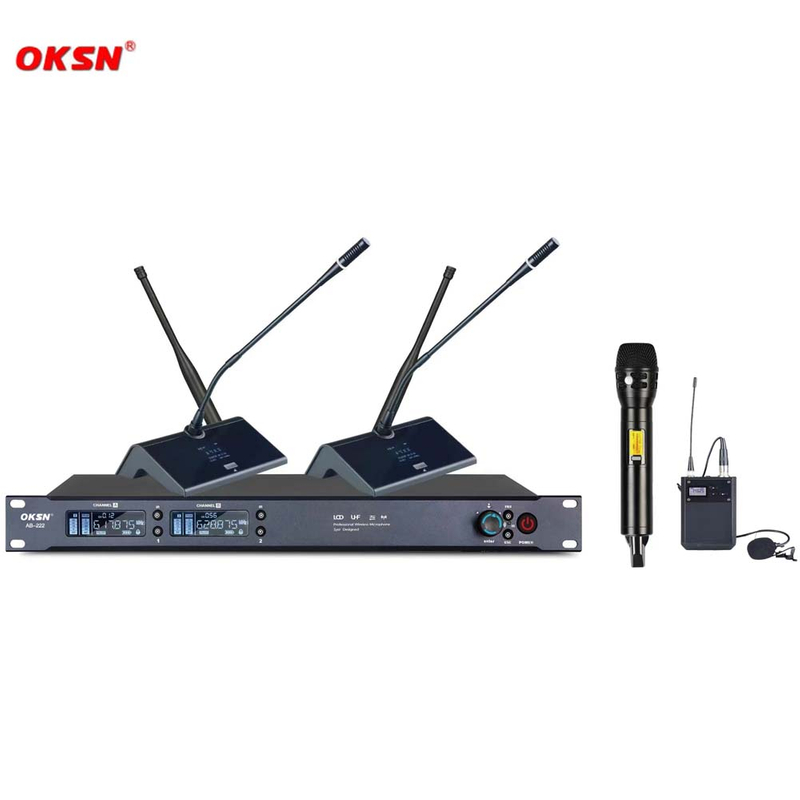
The range depends on the specific model and the environment (walls and interference can reduce range). However, professional systems like the AB-222 typically offer a working distance of 50 to 150 meters, which is more than sufficient for even the largest hotel ballrooms or convention centers.
For a single USB microphone in a home office, you do not need a mixer. However, for a multi-microphone setup in a conference room, you will need a central control unit or a mixer. This device manages the volume levels of all microphones, prevents feedback, and sends a single, mixed audio signal to your computer or PA system.
Yes, many modern wireless receivers are versatile. For instance, a single receiver system might support a handheld microphone for a presenter and a bodypack (lavalier) for a guest speaker simultaneously. It is important to check the specifications of your receiver to see how many channels it supports.
Wireless microphones operate on radio frequencies. If the frequency is crowded (by TV stations or other wireless devices), you will experience interference. It is vital to choose a system with a carrier frequency range—such as 520MHz-960MHz—that complies with local regulations and offers enough bandwidth to find a clear channel.
Whether you are outfitting a town hall, a university auditorium, or a sleek corporate boardroom, the goal remains the same: seamless communication. A conference call microphone is not just a piece of hardware; it is the bridge that connects ideas and people.
By understanding the specific needs of your space—be it the flexibility of a wireless system or the structure of a gooseneck setup—you can ensure that every meeting is productive and every voice is heard. If you are looking to upgrade your current setup, explore options that offer both reliability and flexibility to future-proof your investment.


