- All
- Product Name
- Product Keyword
- Product Model
- Product Summary
- Product Description
- Multi Field Search
Views: 2 Author: Site Editor Publish Time: 2026-07-03 Origin: Site
Choosing between an instrument microphone, a wireless microphone system, and a wired headset microphone depends on your use case. Instrument microphones suit live drumming and studio recording; wireless systems offer freedom of movement for performers; wired microphones deliver reliable, budget-friendly audio for everyday use.
The microphone market has never offered more choice—and that's both a blessing and a problem. Musicians, event organizers, teachers, and audio engineers all need different things from their microphones. Pick the wrong type, and you'll either compromise your sound quality, tangle yourself in cables mid-performance, or overspend on features you'll never use.
This guide breaks down three major microphone categories—instrument microphones, wireless microphone systems, and wired microphones—so you can make a confident, informed decision. We'll also look at real-world products from OKSN Electronics to illustrate what each type can deliver in practice.
An instrument microphone is a specialized microphone designed to capture the acoustic output of musical instruments with precision. Unlike general-purpose microphones, instrument microphones are engineered to handle specific frequency ranges and sound pressure levels associated with different instruments.
The OKSN SN-1100 Wireless Microphone Mic System is a strong example of a professional instrument microphone assembly. The SN-1100 kit includes several microphone types tailored to specific roles:
Big drum microphones — designed for kick drums and low-frequency instruments, thanks to a frequency response optimized for deep bass
Small drum microphones — ideal for tom-toms and snare drums
Condenser microphones — excellent for capturing the detail of cymbals and pianos
Each microphone in the SN-1100 series uses a standard 5/8" or 3/8" thread mount, making them compatible with all common microphone stands. A standard XLR (Female) connector ensures compatibility with professional audio equipment. The full kit comes in a lightweight, durable carrying case with anti-collision sponge padding—practical protection for gigging musicians who travel regularly.
Instrument microphones are the right choice if you're a drummer, live musician, recording engineer, or venue sound technician who needs purpose-built audio capture for specific instruments.
Wireless microphone systems transmit audio signals via radio frequency instead of a physical cable. This freedom of movement makes them popular for live performances, presentations, fitness instructors, and broadcast applications.
The OKSN SN-333S is a UHF frequency-hopping wireless microphone system built for professional use. Frequency-hopping technology allows the system to automatically switch between frequencies to avoid interference—a key advantage over fixed-frequency wireless systems in crowded RF environments.
Here are the key technical specifications of the SN-333S:
Frequency range: UHF 550–960 MHz
Audio dynamic range: >105 dB
Signal-to-noise ratio: >103 dB
RF sensitivity: -105 dBm
Mirror frequency rejection: >110 dB
Coverage range: 60 meters
Frequency response: 40 Hz–18 KHz
Channels: 20 adjustable frequencies per channel (A and B channels available)
Battery life: 5 hours on 2x AA batteries
Output: XLR balanced and 1/4" unbalanced plug
A dynamic range exceeding 105 dB and a frequency response from 40 Hz to 18 KHz make the SN-333S suitable for demanding live sound applications. The 60-meter coverage range provides enough freedom for most stage and classroom environments.
Wireless systems like the SN-333S are the better choice when movement is a priority—think live vocalists, keynote speakers, fitness coaches, or theater performers.
Wired microphones remain the workhorse of the audio industry. No batteries, no signal dropouts, no interference. They plug in and work.
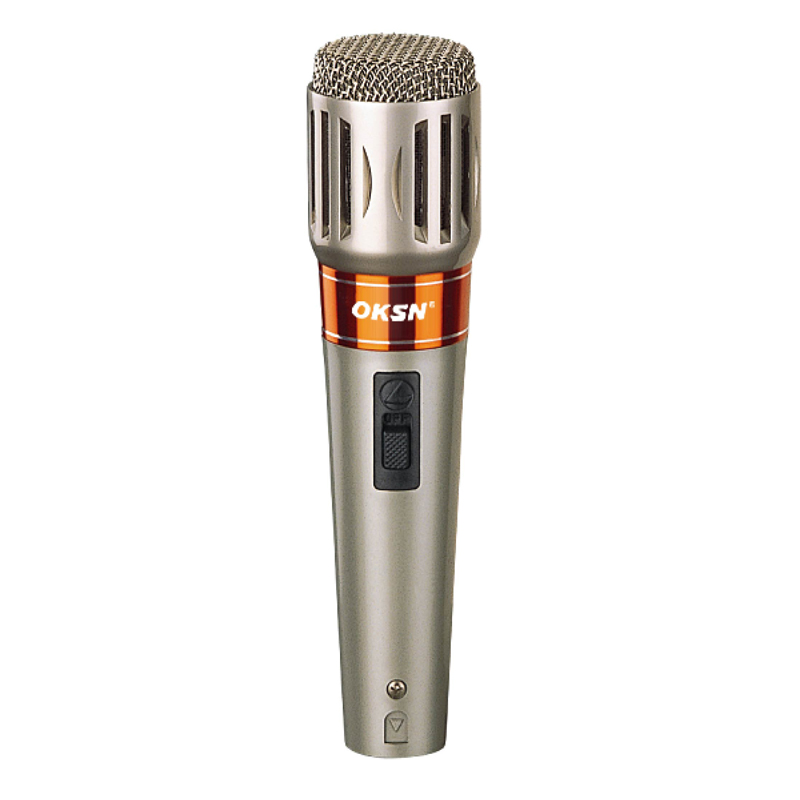
The OKSN DM-217 is a budget-friendly wired dynamic microphone with a metal body, designed for reliable everyday use. Its specifications are straightforward:
Capsule type: Dynamic
Frequency response: 50 Hz–15 KHz
Polar pattern: Uni-directional (cardioid)
Output impedance: 600Ω ±30% (at 1 KHz)
Sensitivity: -75 ±25 dB
The uni-directional polar pattern focuses pickup directly in front of the microphone, rejecting background noise from the sides and rear. This makes the DM-217 well suited for KTV, karaoke venues, small event stages, and rehearsal spaces where a simple, cost-effective solution is all that's needed.
Wired microphones are the right pick when audio reliability takes priority over mobility—recording studios, fixed podiums, and high-turnover rental fleets all benefit from the zero-maintenance simplicity of a wired connection.
The table below summarizes the key differences across all three microphone types to help you decide quickly:
Feature | Instrument Microphone (SN-1100) | Wireless Mic System (SN-333S) | Wired Microphone (DM-217) |
|---|---|---|---|
Best Use Case | Live instruments & studio recording | Live performance & presentations | KTV, events & general use |
Connectivity | XLR (wired) | UHF wireless | Wired |
Frequency Response | Varies by mic type | 40 Hz–18 KHz | 50 Hz–15 KHz |
Mobility | Limited (stand-mounted) | High (60m range) | Low |
Battery Required | No | Yes (5hr life, 2x AA) | No |
Signal Interference Risk | None | Low (frequency hopping) | None |
Polar Pattern | Varies by mic type | Varies by transmitter | Uni-directional |
Portability | Carrying case included | Moderate | High |
Price Point | Mid–High | Mid–High | Budget-friendly |
Ideal User | Musicians, engineers | Performers, speakers | General users |
Start with your use case. Three questions will narrow your decision quickly:
Do you need to capture live instruments? An instrument microphone system like the SN-1100 is built specifically for this. General-purpose microphones often struggle with the frequency demands and sound pressure levels produced by drum kits and acoustic instruments.
Do you need to move freely during use? A wireless system like the SN-333S removes physical constraints entirely. The 60-meter range and frequency-hopping stability make it a practical choice for performers and educators alike.
Do you need a reliable, low-cost solution for fixed use? The DM-217's wired dynamic design delivers clean, interference-free audio without the need for batteries or RF management. For high-traffic venues or entry-level setups, it's hard to beat.
Instrument microphones, wireless systems, and wired microphones each solve a different problem. Match the microphone to the task—not the other way around.
OKSN Electronics, backed by over 20 years of manufacturing experience, produces professional microphone solutions across all three categories. From the specialized SN-1100 instrument microphone kit to the feature-rich SN-333S wireless system and the dependable DM-217 wired dynamic microphone, the range covers most professional and commercial audio needs.
To explore OKSN's full microphone lineup or make an inquiry, visit oksn.com.cn or contact the sales team directly at sales5@oksn.com.cn.
An instrument microphone is designed to capture the sound of specific musical instruments accurately. Different instrument microphones are optimized for different frequency ranges—big drum microphones for low-frequency bass instruments, condenser microphones for cymbals and pianos, and small drum microphones for snare drums and tom-toms.
A wired microphone transmits audio through a physical cable, offering zero signal interference and no battery dependency. A wireless microphone uses radio frequency transmission to send audio to a receiver, allowing freedom of movement. Wireless systems like the SN-333S use frequency-hopping UHF technology to minimize interference.
The OKSN SN-333S wireless microphone system has a coverage range of 60 meters. Range varies by model and environment—walls, electronic equipment, and RF interference can reduce effective range.
Wireless microphones are generally preferred for live performance because they allow performers to move freely. Wired microphones are better for fixed positions where signal reliability and low cost matter more than mobility.
Frequency-hopping is a technology that automatically switches the operating frequency of a wireless microphone system to avoid radio interference. The OKSN SN-333S offers 20 adjustable frequencies per channel across the UHF 550–960 MHz range, making it more stable in environments with heavy RF activity.